
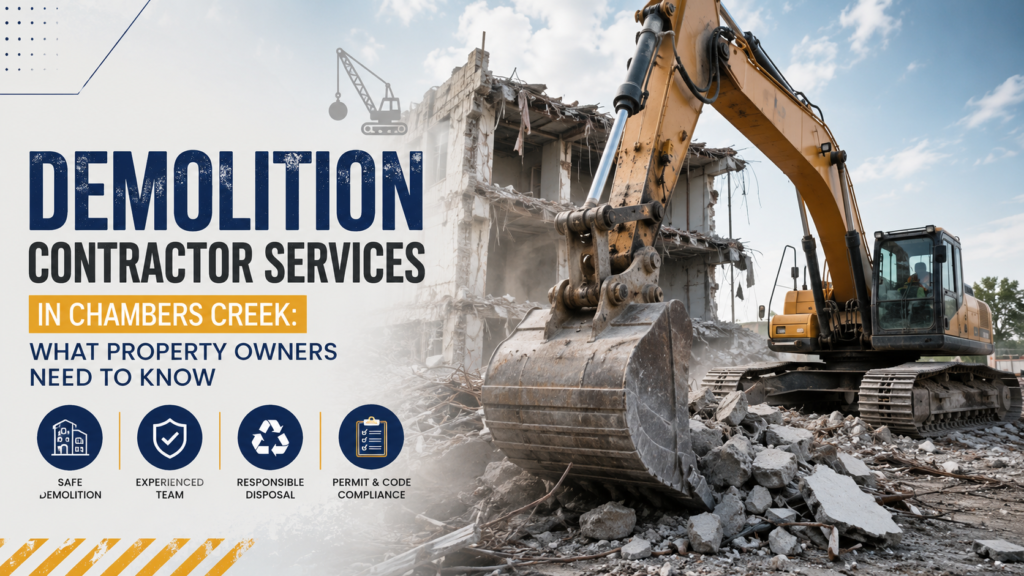
Chambers Creek is a community situated in the Greater Houston area of Texas, within a region that has experienced significant residential and commercial growth over recent decades. The area falls within a larger corridor of development extending from Houston northward through Harris and Montgomery Counties, where property owners regularly need professional Demolition Contractor Chambers Creek services for projects ranging from small residential teardowns to site preparation for new construction. Understanding how demolition contracting works in this area and what distinguishes quality contractors from the rest is valuable knowledge for any property owner considering demolition work.
Demolition Needs in the Chambers Creek Area
The Chambers Creek community and its surroundings reflect the broader development patterns of the Greater Houston region. New residential development has been expanding northward from Houston for decades, bringing with it the full lifecycle of property development including the demolition of older structures to make way for updated or higher-density development. At the same time, established properties in the area contain structures that have aged to the point where demolition and replacement is more economical than continued repair and maintenance.
Residential demolition requests in the area commonly include full house demolition for property redevelopment, garage and outbuilding removal, interior demolition before renovation projects, pool removal, concrete removal from driveways and pads, and mobile home or manufactured housing demolition. Commercial demolition serves local businesses, developers, and municipalities undertaking redevelopment or facility upgrade projects.
How Demolition Projects in the Houston Area Are Structured
Professional demolition contracting in the Greater Houston area follows a structured approach designed to ensure safety, regulatory compliance, and efficient execution. The process begins with a pre-demolition assessment that evaluates the structure, identifies potential hazardous materials, and documents existing conditions. Given that the Houston area has a significant stock of older construction, the presence of asbestos-containing materials in structures built before 1980 is a realistic consideration.
The Texas Commission on Environmental Quality (TCEQ) governs asbestos inspection and abatement requirements in Texas. Before any demolition of a structure that may contain asbestos, a licensed asbestos inspector must survey the building, and any regulated asbestos-containing materials must be removed and properly disposed of by a licensed abatement contractor before demolition proceeds. This requirement applies to both residential and commercial demolition projects.
Permit requirements for demolition in Texas vary by municipality and unincorporated county area. Incorporated cities in the region typically require demolition permits through their building departments, while unincorporated county areas may have different or fewer requirements. Experienced Houston-area demolition contractors navigate these jurisdiction-specific requirements routinely and handle permit acquisition as part of their project management.
Texas-Specific Regulatory Considerations for Demolition
Texas’s regulatory approach to demolition differs from California’s in several notable ways. Texas generally has fewer statewide mandates around construction debris recycling, though local municipalities may have their own requirements. The Houston area’s industrial heritage means that some demolition sites particularly in commercial or industrial contexts may involve environmental site assessment requirements beyond standard asbestos surveys, including investigation for soil or groundwater contamination from prior uses.
Houston’s flat topography and expansive clay soils create some distinctive considerations for demolition and site preparation. The region’s rainfall patterns including the significant precipitation events that can affect Harris and Montgomery Counties mean that site drainage must be carefully managed during and after demolition. Contractors familiar with Houston-area soil conditions understand how to plan earthwork and site preparation activities to account for these drainage dynamics.
Utility infrastructure in the Greater Houston area includes a complex network of underground lines gas, water, telecommunications, and stormwater systems that must be identified and protected before any demolition or excavation begins. Texas law requires notification through the Lone Star 811 system before digging, and responsible demolition contractors treat this as a non-negotiable step in project preparation.
Equipment and Capabilities for Chambers Creek Demolition Projects
Demolition projects in the Chambers Creek area require contractors with appropriate equipment for the project scope. Full residential demolition typically employs excavators in the 20-to-40-ton range, capable of efficiently breaking apart wood frame or masonry structures and loading debris for hauling. Mini excavators find use in tighter sites where access is limited or where adjacent structures need protection.
Concrete removal a common requirement given the prevalence of concrete slabs, driveways, and pool decks throughout the area requires hydraulic breaker attachments on excavators or specialized concrete saws to break material into manageable pieces. Skid steers assist with debris loading and site cleanup. Hauling trucks preferably operated by the demolition company itself rather than contracted separately are essential for efficient debris removal.
Site preparation capabilities are an important value-add for demolition contractors working in development-active areas like Chambers Creek. After a structure is removed, the site typically needs to be graded, compacted, and prepared for its next use. Contractors who can perform this follow-on site work in-house offer developers and property owners a more streamlined experience.
Selecting a Demolition Contractor in the Chambers Creek Area
Choosing a demolition contractor for a project in the Chambers Creek area involves evaluating several factors. Texas contractor licensing requirements at the state level are more limited than in some other states Texas does not have a universal general contractor license requirement at the state level, though municipalities may have their own registration or licensing requirements. This makes verification of insurance, experience, and references particularly important in Texas.
Insurance is a non-negotiable requirement. A demolition contractor without adequate general liability and workers compensation coverage creates significant risk for property owners. Before signing any agreement, verify that the contractor carries current, adequate coverage and is willing to provide certificates of insurance naming the property owner.
Local references and project history provide the most direct evidence of a contractor’s capabilities and reliability. A contractor who has successfully completed similar projects in the Chambers Creek area or surrounding communities brings relevant local knowledge familiarity with local soil conditions, utility infrastructure, municipal permit processes, and disposal facilities that translates into smoother project execution.
Common Questions About Demolition in Chambers Creek
Do I need a permit to demolish a structure in the Chambers Creek area? Permit requirements depend on the specific jurisdiction whether the property is within an incorporated city or in unincorporated county territory. Your demolition contractor should be able to advise on what permits apply to your project location.
How is debris disposed of after demolition? Debris is typically hauled to permitted disposal facilities in the Houston metro area. Concrete and metal may be recycled, while general demolition waste goes to landfill. Contractors managing their own hauling fleets provide more consistent and predictable debris removal than those relying on third-party haulers.
Can the demolition contractor handle site preparation after the teardown? Many full-service demolition contractors in the Greater Houston area also offer site grading, earthmoving, and initial site preparation services. This combined capability allows for a seamless transition from demolition completion to new construction preparation.